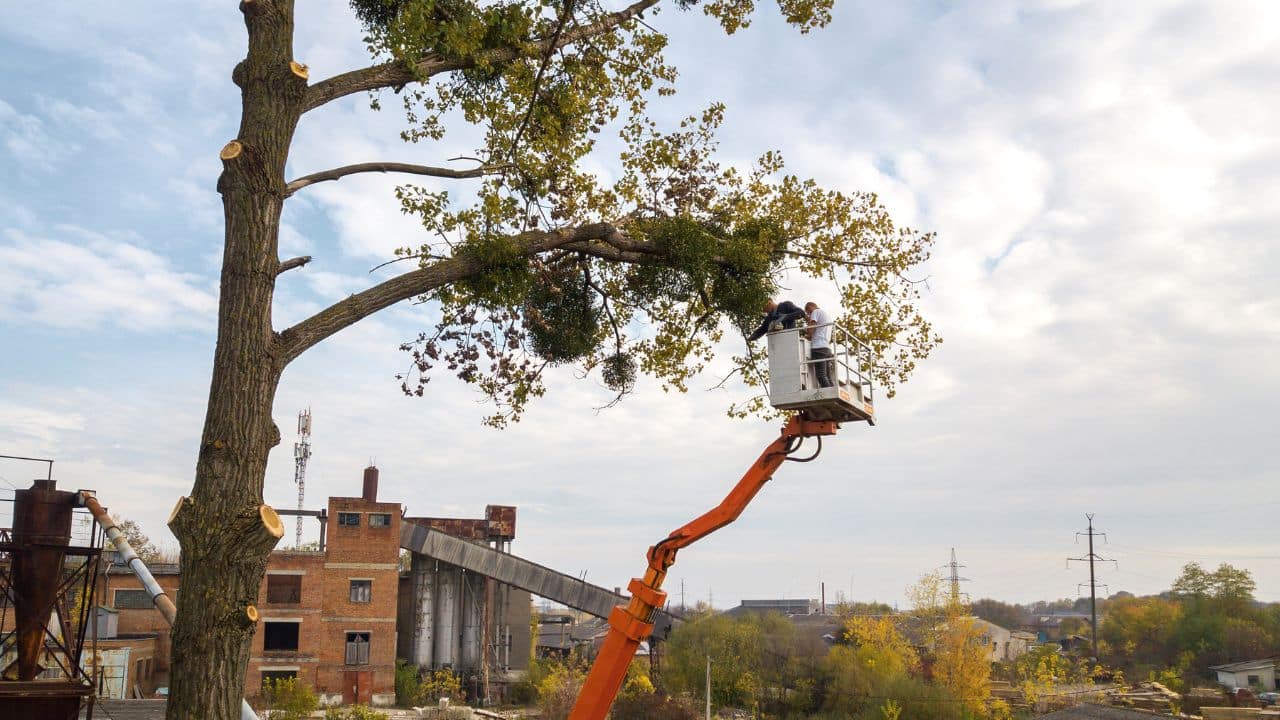
Safe, owner-operated removal of hazardous, dead and unwanted trees.
Creative Tree & Stump LLC is a Brighton, CO-based tree removal company serving 22 communities across Adams, Weld, Jefferson, Boulder, Broomfield, and Denver counties. We've removed hundreds of trees across Brighton and greater Adams County since 1991, and Shawn Brandau — an ISA Certified Arborist — is on every job personally.
Brighton sits at roughly 4,984 ft on the Front Range, where high winds, late frosts and periodic drought stress brittle species like cottonwood, ash and Austrian pine. Per Colorado State Forest Service guidance, hazardous trees near structures should be addressed before storm season — a tree that limps through summer with deadwood and a lean is exactly the one that fails in the first heavy snow. Not every declining tree needs to come down, though; an ash with a healthy canopy can sometimes be treated for emerald ash borer rather than removed. Removal is the last resort, not the default — but when a tree is truly hazardous, dealing with it promptly is the safest and ultimately the cheapest path.
From a single hazardous limb to crane-assisted picks over your roofline — every job led by an owner who shows up. Each service below is part of the same removal practice and priced together, so a multi-tree job costs less than booking each piece separately.
Same-day response for fallen and hazardous trees, any hour of the day or night.
Emergency tree removal →Big, leaning or compromised trees taken down safely near homes, fences and lines.
Large & hazardous removal →In-house crane for tight lots and oversized trees — no subcontractor markup.
Crane-assisted removal →Remove failing trees before they fail on their own in a windstorm.
Dead & diseased removal →Specialized handling of brittle, heavy Front Range cottonwoods and their roots.
Cottonwood removal →Removing ash lost to emerald ash borer — or assessing whether yours can be saved.
Ash & EAB removal →Shawn assesses the tree, access and risks, then gives transparent pricing.
We confirm drop zones, rigging or crane needs, and any local permits.
Sectional dismantling or directional felling to ANSI Z133 standards.
Front Range removals are done one of three ways: directional felling in open space, rigging and sectional dismantling near structures, or a crane pick for the largest and tightest jobs. Creative Tree & Stump owns its crane, so there is no waiting on a subcontractor and no markup for rented equipment — and the same owner-led crew runs the rigging and the saw. Bringing all three methods in-house also keeps timelines tight, since we are never waiting on a third party to arrive with a machine.
Which method we use depends on the target. In an open backyard with no fences or lines, a skilled feller can drop a tree in one piece quickly and safely. Closer to a house, garage or fence, we climb or use a bucket and lower the limbs on ropes in controlled sections so nothing free-falls. For the biggest trees, or trees boxed in by structures on every side, the crane lifts each section straight up and out — faster, and with far less risk to the property than muscling heavy wood down by hand. Owning the crane means we can make that call on its merits, not on equipment-rental cost.
Every removal follows ANSI Z133, the national safety standard for arboricultural operations, which governs electrical-hazard clearances, drop-zone control and rigging loads. The most common serious tree-work injuries in the United States involve electrocution and struck-by limbs, so near overhead power lines we coordinate clearances and work to safe distances rather than risking contact. That discipline is exactly why removal beside a home is not a do-it-yourself weekend project.
A tree should be removed when it is dead, structurally unsound, leaning toward a target, or so diseased that treatment will not save it. Warning signs include a sudden lean, large dead limbs over the house, mushrooms or conks at the base (a sign of internal decay), deep trunk cracks, and root-plate heaving after a storm. Any of these near a building or walkway is a reason to call sooner rather than later.
On the Front Range, timing is rarely on your side. Downslope windstorms and heavy, wet spring snows are what actually bring marginal trees down — usually onto whatever is beneath them. A cottonwood or Siberian elm that survives summer with deadwood and a lean is the classic candidate for failure in the next windstorm. If you have already spotted a hazard, the cheapest time to deal with it is now, on the ground and on your schedule, rather than as an emergency after it has landed on the fence or the roof. Brighton, Thornton and Commerce City see these wind events every year, and the trees that come down are almost always the ones a homeowner had already worried about.
Not every struggling tree needs to come down. A tree with minor deadwood may only need a structural prune, and a declining ash may still respond to treatment. We evaluate each tree against formal tree risk-assessment criteria — likelihood of failure and the value of what it could hit — and tell you honestly whether removal is the right call or an over-reaction.
Removal and trimming solve different problems. Removal is for trees that are dead, dangerous or unwanted; trimming and pruning keep a healthy tree safe, shapely and clear of structures. If a tree is structurally sound but dropping limbs or crowding the roofline, a structural prune is usually cheaper and preserves the shade, property value and wind protection that a mature Front Range tree provides.
We recommend the lightest effective option. If your tree can be saved with pruning, we will say so rather than sell you a removal — and if it cannot, we will explain exactly why. When you are not sure removal is necessary, our tree trimming and pruning services are the place to start.
Cleanup is part of the job, not an upsell. We haul off all logs and brush, rake the work area, and leave your yard cleaner than we found it. Usable wood can be cut to firewood length and stacked on site if you want it; the rest is chipped or hauled to a recycler. Nothing is left for you to drag to the curb. If your HOA or city has debris-disposal rules, we handle haul-off in line with them so you are not left explaining a pile of branches.
The stump remains unless you add grinding, which removes it 4–8 inches below grade so you can re-sod or replant. For large cottonwoods and other heavy species, surface roots may also need attention once the trunk is gone, since they can buckle sidewalks and lawns. We will flag any of that in your estimate so there are no surprises after the chipper leaves.
Tree-removal cost in Colorado is driven by four things: size, species, access and proximity to structures. As a rough guide, small trees typically run $200–$500, medium trees $500–$1,100, and large or crane-assisted removals higher; stump grinding is a separate add-on quoted with the job. Brittle, heavy species like cottonwood often cost more than a comparable maple because of how carefully they must be rigged.
Access matters as much as size. A cottonwood overhanging a roofline in a tight Brighton backyard costs more than the same-size tree in an open field, because rigging, crane access and drop-zone control drive the price as much as trunk diameter does. You can get a ballpark figure first with our free tree-removal cost estimator, then confirm it with a no-obligation on-site visit from the owner.
A good removal quote is all-in. Ours includes the takedown, full debris haul-off and cleanup; stump grinding, surface-root removal and any required city permit are listed separately so you can see exactly what you are paying for. Be wary of a bid that comes in far below the others — in tree work, a lowball price often means no insurance, which leaves you liable if a limb damages your roof or a worker is hurt on your property. We carry full insurance and will show proof on request.
Owner-operated since 1991. Not a franchise, and not a crew you've never met.
Shawn Brandau personally leads every removal across the Front Range.
An ISA Certified Arborist on the job and full insurance on every project.
Cottonwood, ash, spruce, elm, locust — we know how Colorado trees fail.
Based in Brighton, serving 22 communities across Adams, Weld, Jefferson, Boulder, Broomfield and Denver counties — the same owner-led crew, whatever the drive time.
Creative Tree & Stump is rated highly across Brighton and the Denver metro for safe, owner-led removals. Every review is read and answered personally, and the most recent ratings tell you the most about the service you can expect today. Read verified Google reviews on our customer reviews page.
Most tree removals in Colorado range from about $200–$500 for small trees to $500–$1,100 for medium trees, with large or crane-assisted removals running higher. Final cost depends on size, species, access and proximity to structures. We give a free, transparent on-site estimate before any work begins.
There is no statewide tree-removal permit, but many Front Range cities regulate work on street and right-of-way trees and require a licensed tree-service company. We confirm any local permit requirements for your city before we start.
Hazardous trees should be removed as soon as they are identified. For ash trees affected by emerald ash borer, the ideal window is September 1–April 30, when larvae are under the bark and the pest is not spreading.
Yes — Creative Tree & Stump LLC provides 24/7 emergency tree removal across Brighton, Thornton, Commerce City and all 22 service-area cities. Call (970) 580-6932 for same-day response.
Stump grinding is a separate add-on quoted with your removal. We grind stumps 4–8 inches below grade and clean up the chips so you can replant or re-sod.
Yes. Tight, high-target removals are routine for us — we use rigging and our in-house crane to dismantle the tree in controlled sections, and we coordinate clearances near power lines to ANSI Z133 standards.
We plan access to protect your property, using mats or careful routing when heavy equipment must cross turf, and we control where wood is lowered. On tight Front Range lots that is exactly why a crane is often the gentler option — it lifts wood straight out instead of dragging it across the yard. Any unavoidable impact, such as ruts in soft spring ground, is discussed before we start.
Yes, year-round. Winter is actually a good time for many removals: the ground is firm, deciduous trees are bare and easier to rig, and disease transmission is lowest. Storm and hazard removals are handled in any season, day or night.
Get a free on-site estimate from the owner himself — no pressure, no franchise middlemen.