
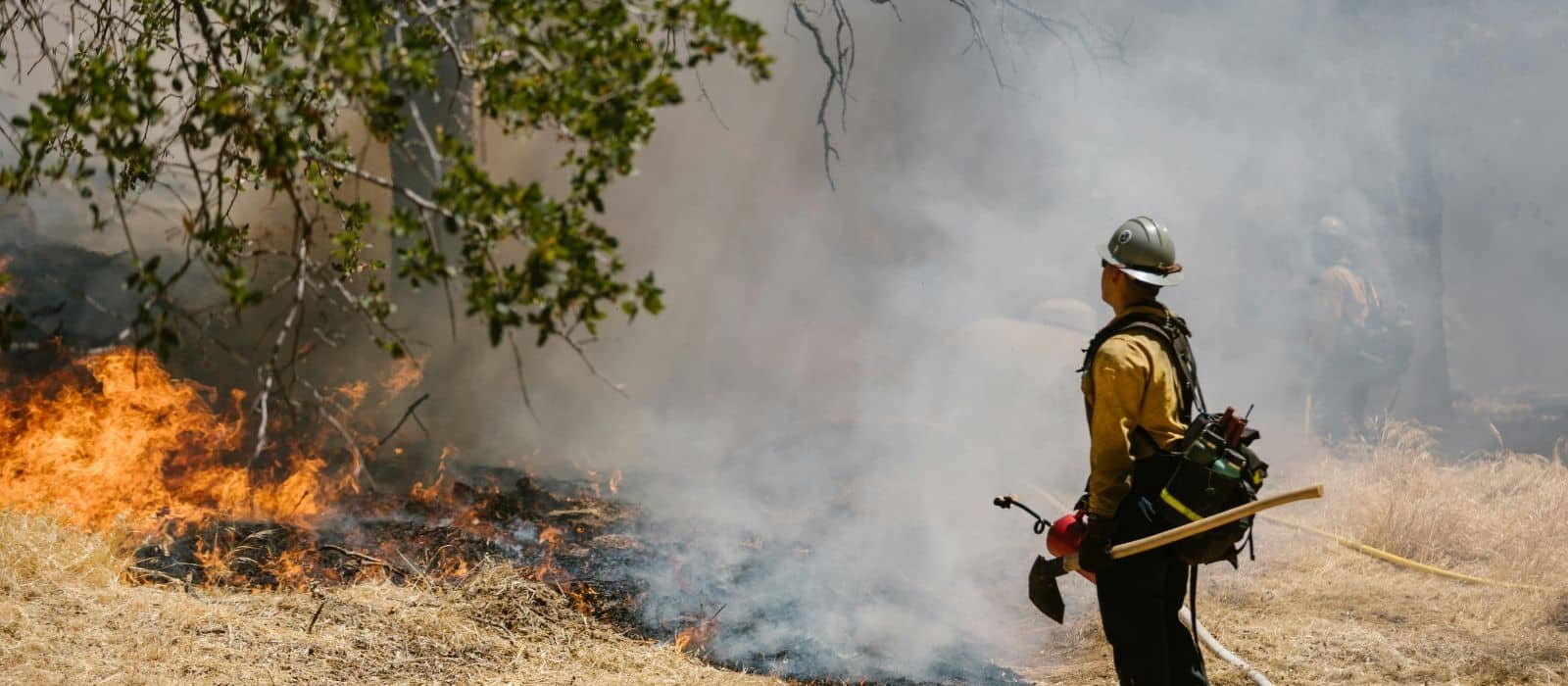
Defensible space and fuels work for Front Range properties.
Creative Tree & Stump LLC is a Brighton, CO-based tree removal company serving 22 communities across Adams, Weld, Jefferson, Boulder, Broomfield, and Denver counties. Shawn Brandau, an ISA Certified Arborist who has worked Front Range properties since 1991, does fuels-reduction and defensible-space work to Colorado State Forest Service (CSFS) guidelines, and the company is fully insured. Not sure where your property stands? Start with our wildfire risk assessment tool, then book a free on-site assessment in Brighton or anywhere across the metro, and we will walk the property with you and lay out a clear, prioritized plan to follow.
Wildfire on the Front Range is not only a mountain problem. Wind-driven grass fire moves fast across the open spaces and fields that border many of our communities, throwing embers far ahead of the flames — exactly how the Marshall Fire destroyed more than a thousand homes in suburban Boulder County. Defensible space and ember-resistant landscaping are what stand between those embers and your house. The good news is that this is the one part of wildfire risk a homeowner can genuinely control and act on today.
Four core services that reduce the fuels around your home — done individually or as a complete defensible-space plan.
Removing low limbs and brush so surface fire can’t climb into crowns.
Ladder fuel reduction →Fire-resistant species, spacing and an ember-resistant home zone.
Firewise landscaping →Hauling and chipping the branches and brush mitigation leaves behind.
Slash removal & chipping →The Front Range combines everything wildfire needs. Long stretches of cured grass and brush border subdivisions, fields and open space; the area sees regular drought and dangerously low humidity; and the same downslope windstorms that knock down trees can push a grass fire across the landscape faster than a person can run. Decades of building outward into the wildland-urban interface have put far more homes directly in that path, and grass fire ignites and spreads more easily than many people expect, often from something as small as a spark in dry roadside grass.
The Marshall Fire on December 30, 2021 is the hard proof. It was not a forest fire — it was a wind-driven grass fire that tore through suburban Boulder County and destroyed more than a thousand homes in hours, in neighborhoods that looked nothing like the mountains. What carried it from house to house was not a wall of flame but a storm of windblown embers landing in dry mulch, on wood fences, and against siding. That is the threat defensible space is designed to interrupt — breaking the chain of fuels that lets embers turn into a house fire.
Mitigation works because most homes do not burn from the main flame front — they ignite from embers and from fuels burning right next to the structure. By removing dead material, spacing trees and shrubs so fire cannot spread crown to crown, and clearing the area immediately around the house, defensible space lowers the intensity of any fire that reaches your property and removes the fine fuels that embers need to catch and hold long enough to start a structure burning.
It does two things at once: it improves your home’s own odds of surviving on its own, and it creates a safer space for firefighters to actually stand and defend the structure if they are there. None of it guarantees a house survives — nothing does — but well-built defensible space measurably shifts the odds, which is why the state, the CSFS and insurers all now point to it as the foundation of wildfire preparedness. It is the highest-value work you can do, and it starts at the house and works outward.
The Colorado State Forest Service organizes defensible space into concentric zones, each with a different job. Zone 1, generally the first 30 feet around the home, is the most critical: lean, clean and green, with dead vegetation removed, shrubs and trees well spaced, and nothing flammable touching the structure. Zone 2, roughly 30 to 100 feet out, is a fuel-reduction zone where trees are thinned, crowns are spaced apart, and low limbs are pruned up to break the connection between the ground and the canopy.
Zone 3, the area beyond 100 feet out to the property line, is managed more lightly to keep fire on the ground and slow its approach. Newer guidance adds an even more important innermost band — the noncombustible 0-to-5-foot zone right against the house, where embers most often start a home on fire. We work all of these zones to current standards, prioritizing the ones closest to the structure first, because that is where mitigation does the most good. If a budget only stretches so far, the dollars spent nearest the house protect it best, and we will tell you exactly where the work should start.
Colorado now has its first statewide wildfire-resiliency building code. The 2025 Colorado Wildfire Resiliency Code (CWRC), developed by the state’s Wildfire Resiliency Code Board, applies to construction and property maintenance in designated wildland-urban interface (WUI) areas, and jurisdictions with WUI land are working toward full compliance by July 1, 2026. It pairs hardening the structure itself with reducing fire risk in the defensible space around it — which is the tree and vegetation work we do. If your jurisdiction sits in a designated WUI area, defensible space is moving from good idea to expectation.
There is an insurance angle too. Colorado’s HB 25-1182 requires property insurers that use wildfire risk scores to account for mitigation work and to disclose those scores to homeowners, so the defensible space you create can factor into how your wildfire risk — and potentially your premium — is assessed. Either way, the work starts the same: thinning fuels, spacing trees, and clearing dead material. Standing dead trees are some of the worst offenders — they are dry, they burn readily, and they throw embers downwind — so removing them matters, and we handle dead and diseased tree removal alongside mitigation.
Owner-operated since 1991. We work to CSFS guidelines, prioritize the zones that actually protect your home, and never sell clearing you do not need.
An ISA Certified Arborist plans the work and our crews carry it out — fully insured.
Defensible space built to recognized Colorado State Forest Service standards, not guesswork.
We haul and chip the slash, so your finished defensible space is actually clean.
Defensible space matters most for properties in or near the wildland-urban interface and the grassland edges that border the metro, across our 22-community service area. The genuinely fire-exposed communities we serve sit near the foothills and open space — places like Boulder, where forest and neighborhoods meet directly along the foothills.
The grassland interface runs through the north metro too, not just the mountains. Lafayette and the open space around it face real exposure, as does neighboring Louisville, which lost homes in the Marshall Fire just a few years ago. If your property backs onto a field, a greenbelt or open space, the same logic applies to you.
Creative Tree & Stump is rated highly across Brighton and the Denver metro, including from homeowners who had defensible space and fuels-reduction work done before fire season. Every review is read and answered personally, and the most recent ratings tell you the most about the service you can expect today. Read verified Google reviews on our customer reviews page.
It is a buffer of thinned and managed vegetation around a home that slows an advancing wildfire and gives firefighters room to defend the structure. It is created by spacing trees, removing dead material and ladder fuels, and keeping the area nearest the house clear of anything flammable, so a fire arrives with less to burn.
The Colorado State Forest Service recommends managing vegetation out to at least 100 feet where space allows, in zones: a lean, clean Zone 1 in the first 30 feet, a thinned Zone 2 from 30 to 100 feet, and lighter management beyond. The 0-to-5-foot band right against the house is the most critical of all, because that is where wind-blown embers land and ignite a structure most easily.
Yes. The 2021 Marshall Fire destroyed more than a thousand suburban homes in Boulder County, driven by wind and grass, not forest. Any property near open space, fields or the wildland-urban interface benefits from defensible space — embers travel far ahead of the fire itself, sometimes a mile or more, landing on homes well before the flames arrive.
It is Colorado’s first statewide wildfire building code, adopted in 2025 and rolling out across designated wildland-urban interface areas, with jurisdictions working toward full compliance by July 1, 2026. It addresses both hardening the structure and reducing fire risk in the defensible space around it, and local governments in WUI areas must adopt standards that meet or exceed the state code, so requirements are tightening across the interface.
It can factor in. Colorado’s HB 25-1182 requires insurers that use wildfire risk scores to account for mitigation and disclose those scores, so documented defensible-space work may help your risk assessment. We are not insurance advisors, but we can document the defensible-space work we do for you, with photos, to share with your insurer or agent when you ask about mitigation recognition.
Ladder fuels are the low branches, shrubs and tall grass that let a surface fire climb up into the tree canopy, where it becomes far more dangerous. Removing them — by pruning low limbs and clearing brush under trees — breaks that vertical path so a grass or surface fire stays on the ground instead of climbing up and torching the whole tree into a far more dangerous crown fire.
We haul it away or chip it on site, because slash left lying around just becomes more fuel. Chips can be used as mulch away from the home’s ignition zone or hauled off entirely — never piled against the house, where it would become a fire risk of its own — and we leave your finished defensible space clean.
Ideally before fire season, and it works best as ongoing maintenance rather than a one-time clearing — grass and brush grow back. Late winter through spring is a good time to get ahead of it, but we assess and work properties year-round, and any reduction in fuel helps whenever it is done.
 Call Now