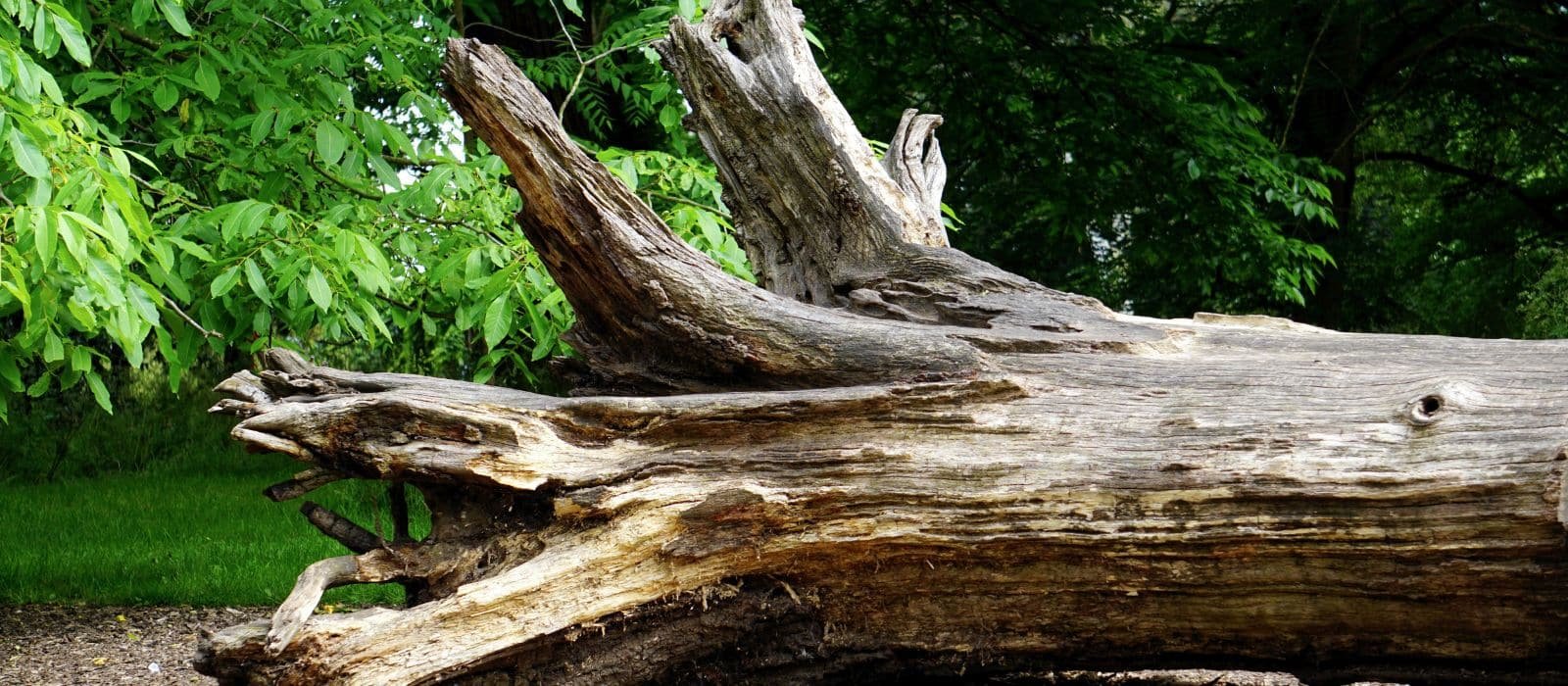
Remove failing trees before they fail on their own.
Creative Tree & Stump LLC is a Brighton, CO-based tree removal company serving 22 communities across Adams, Weld, Jefferson, Boulder, Broomfield, and Denver counties. Shawn Brandau, an ISA Certified Arborist, has diagnosed and removed declining trees across the Front Range since 1991, and the company is fully insured — so the same person who tells you a tree is finished is the one who takes it down safely.
Some signs are obvious; others are easy to miss until a limb comes down. Watch for branches with no leaves while the rest of the tree is green, a thinning canopy that gets sparser each year, vertical cracks or seams in the trunk, and soft or hollow-sounding wood. Bark that falls away to reveal smooth, dry wood underneath is a strong indicator that part of the tree has already died.
Fungal fruiting bodies — mushrooms, shelf fungi or conks at the base or on the trunk — point to internal decay that has been advancing for years, even if the tree still leafs out. A tree can be a hazard long before it looks completely dead, which is why a professional assessment beats waiting for the obvious. On older Front Range trees, internal decay can be well advanced while the canopy still looks deceptively full, so when in doubt, have it checked.
On the Front Range, a handful of pests and diseases cause most tree decline. Emerald ash borer is killing untreated ash across the region; ips and spruce beetles attack stressed pines and spruce; and cytospora canker is a frequent killer of blue spruce and cottonwood. Add fireblight in the pear and crabapple family, plus chronic drought and winter desiccation, and you have the short list behind most removals we are called to do.
Across Northglenn and the north metro, the trees we are most often asked to remove are dead ash and declining blue spruce. If your tree is an ash, the first question is whether it can still be treated for emerald ash borer rather than removed — early infestations are often saveable, while advanced ones are not.
Not every sick tree needs to be removed. Many pests and diseases are treatable when caught early — an ash with light emerald ash borer activity, a spruce in the first stage of decline, or a tree simply stressed by drought can often be saved with treatment, deep-root care and corrective pruning. Removal is reserved for trees that are already dead, structurally unsound, or too far gone for treatment to help.
We give you an honest call either way. If a tree can recover, we will say so rather than sell you a removal; if it cannot, we will explain exactly what we are seeing and why taking it down is the safe choice. A dead tree only gets more dangerous and more expensive to remove the longer it stands and the more brittle it becomes.
We remove dead and diseased trees across all 22 of the communities we serve, and we are glad to look at more than one tree on the same visit. When several trees decline together — common after a drought year, or when a pest like emerald ash borer hits a whole block — we prioritize the most dangerous and plan the rest, so you are not paying for separate trips.
Shawn Brandau has diagnosed and removed dead and diseased trees across the Front Range since 1991 — an ISA Certified Arborist making the call, full insurance on every job, and straight answers about what can be saved and what cannot.
Removing ash lost to emerald ash borer — or checking if yours can be saved.
Ash & EAB removal →Dead trees that have grown large or unstable, removed safely.
Large & hazardous removal →Scratch a small twig: living wood is green and moist just under the bark, while dead wood is brown and dry. If branches across the whole tree fail this test and no leaves appear in spring, the tree is likely dead and should be assessed for removal.
Yes, increasingly so. Dead wood becomes brittle and unpredictable, dropping limbs and eventually failing at the trunk — usually in the wind or snow that the Front Range gets plenty of. A dead tree near a home or walkway is a genuine hazard.
Often, if caught early. Many pests and diseases respond to treatment and improved care before decline becomes severe. We assess the species, the problem and how far it has progressed, then recommend treatment or removal honestly. Acting early almost always means more options and a lower cost.
Because dead trees only get more dangerous and more expensive to remove. As the wood dries and weakens, rigging it safely gets harder, and the odds of an uncontrolled failure onto your property rise with every storm. Brittle deadwood is also harder and costlier to rig safely than sound, living wood.
Stump grinding is available as a separate add-on quoted with the removal. We grind 4–8 inches below grade so you can re-sod or replant where the dead tree stood.
 Call Now
